How will Robert Rivas lead the California Assembly?
From CalMatters politics reporter Alexei Koseff:
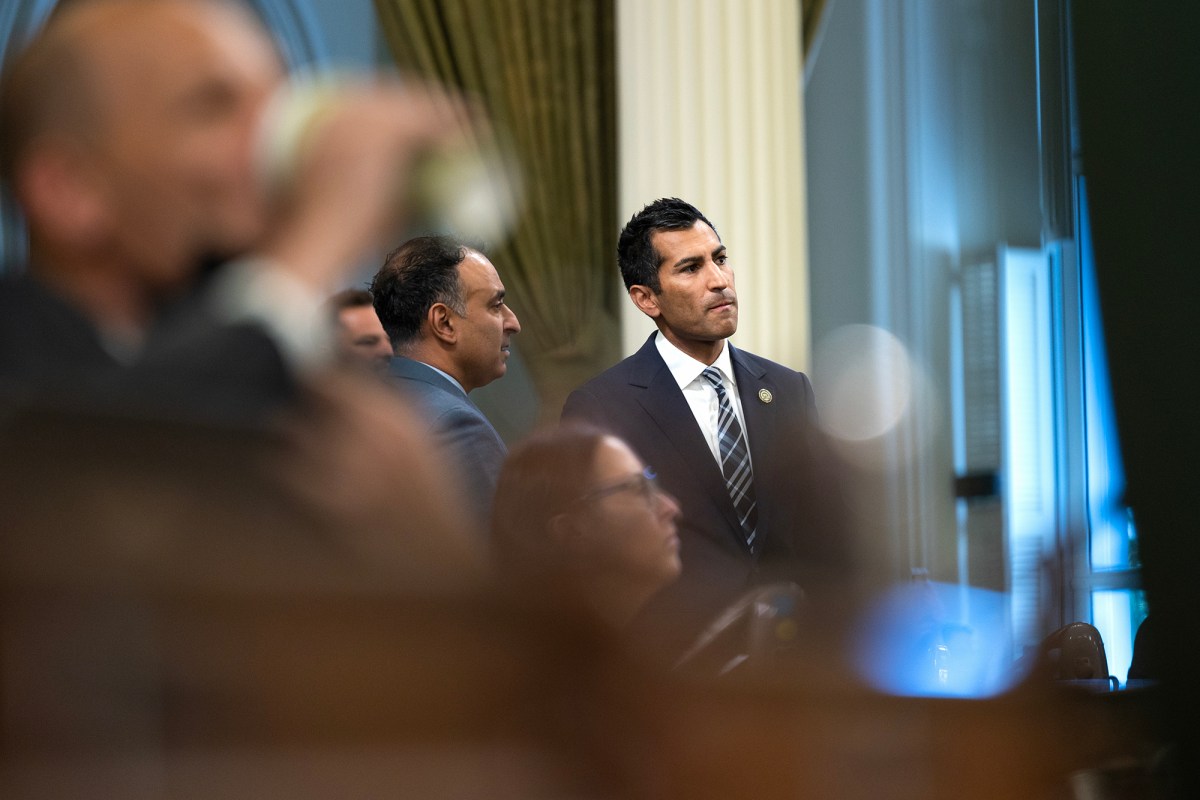
The key to understanding new Assembly Speaker Robert Rivas’ leadership might be his severe childhood stutter.
Growing up, he often had his ears open more than his mouth. Now, Rivas said Wednesday in an interview hosted by the Sacramento Press Club, his greatest strength is hearing people out and engaging with the concerns of his colleagues.
“When sometimes you can’t say things, you have no choice but to listen,” the Salinas Democrat said.
That was the pitch Rivas said he made last year to his fellow Assembly Democrats as he waged a protracted, and highly political, battle with former Speaker Anthony Rendon for control of the lower house of the California Legislature. He would be a convener, inclusive, unifying the caucus’ agenda.
During the interview Wednesday, his first major public event since he was sworn in as speaker less than two weeks ago, Rivas still seemed to be figuring out what exactly that would entail.
Repeatedly emphasizing that it was only his 12th day on the job, Rivas offered few specifics about what might be a priority as the Legislature enters its final month of session, or where he would want to direct the oversight efforts that he suggested during his inaugural speech should be a greater focus for lawmakers.
Rivas did acknowledge that he wants the Assembly to pass Senate Bill 423, a contentious measure to fast-track permits for new apartment buildings in much of the state, which only narrowly advanced out of committee earlier this week when several Democratic and Republican members teamed up to override the chairperson.
“With housing, we continue to just chip around the corners on this problem,” Rivas said. “But people expect us to make progress, and much more progress.”
In a rapid-fire round, he also expressed his support for legalizing psychedelic drugs in California and raising the minimum wage for health care workers to $25 per hour. His favorite Mexican food in Sacramento, he said, is a home-cooked meal from Assemblymember Sharon Quirk-Silva, a Fullerton Democrat.
Rivas tried to draw a sharp professional boundary with his brother, Rick Rivas, who has been his closest political adviser throughout his career and works as a consultant for the American Beverage Association, a soda industry group.
“My brother is not a lobbyist. He’s never lobbied me,” the speaker said. “I will always serve the residents of this state to the best of my ability and always maintain those lines of ethics, of doing things the right way.”
Though they have a tight bond — forged by sharing a bed as children — Robert Rivas said there would be no undue influence from his brother’s clients on his agenda. Rick Rivas also advises Govern For California, a donor network that aims to counteract the influence of public employee unions at the state Capitol and that pushed the boundaries of state campaign finance law as it boosted Robert Rivas’ speakership bid.
“How I won the speakership was through engagement and through the relationships I have built up and down this state,” he said, dismissing the notion that he bought the role. “I take that responsibility very seriously. I certainly appreciate all of the political advice my brother has ever given me. But he has a job to do and so do I.”
CalMatters has impact: The investigation published this week by CalMatters’ Byrhonda Lyons on a parolee reentry program is getting quite a bit of attention. And in case, after reading Monday’s WhatMatters, you were wondering what happened after she started asking questions, here’s the rest of the story:
The California Department of Corrections and Rehabilitation — which oversees the $100 million a year program and had refused repeated requests for interviews — said in emails that the department would begin to track recidivism and the employment rate among participants and would also prevent unlicensed vendors from managing reentry homes and treatment facilities.
- Terri Hardy, department spokesperson, in an email: “CDCR understands the importance of oversight and accountability in this program.”
Also, in the latest CalMatters collaboration with CBS stations in California, a segment on the investigation will air today on CBS Sacramento at 6 p.m. and 10 p.m. and on CBS Los Angeles at 5 p.m. and 9 p.m. and Friday at 7 a.m. and noon.
Youth journalism: CalMatters is ramping up its youth journalism initiative for high school students and educators. That includes an educator fellowship, with a workshop this week at CalMatters’ offices in Sacramento. Here’s a list of participants, plus more on the program. And read more from our engagement team.
Other Stories You Should Know
1 Democrats divided on trafficking bill

From CalMatters politics intern Rya Jetha and politics reporter Alexei Koseff:
Republicans put Democrats on the Assembly public safety committee on full blast for blocking a bill to make human trafficking of a child a serious felony, opening repeat offenders up to longer sentences.
In the aftermath, committee Chairperson Reggie Jones-Sawyer, a Los Angeles Democrat, met Wednesday with the bill’s author, Republican Sen. Shannon Grove of Bakersfield. Afterwards, both legislators called the meeting “productive.” Grove told reporters, “we’re still waiting for results,” while Jones-Sawyer said there “is a pathway forward” for Senate Bill 14.
But it wasn’t at all clear what that pathway might be.
Assembly Republicans aren’t waiting: They tried to force a vote today of the full Assembly in its last floor session before a month-long summer break. The Democratic-controlled chamber didn’t go along, but did send the bill back to the committee, which quickly reversed itself and voted to move it on to the appropriations committee. This morning, one Democrat on the committee, Assemblymember Liz Ortega of Hayward, said she “made a bad decision” and will try to move the bill forward.
While Republicans accuse Democrats of putting criminals over victims and survivors, Jones-Sawyer said in a statement that child sex traffickers already face long sentences and that the three-strikes model in SB 14 “focuses only on punitive actions and does nothing for victims.”
The back-and-forth came after two top Democrats, Gov. Gavin Newsom and Assembly Speaker Robert Rivas, said they had reached out to Grove to find a path forward.
Newsom distanced himself from the committee’s vote on Tuesday, which he said surprised him, particularly since in May, the Senate approved the measure 40-0.
“It’s an area I care deeply about,” Newsom told reporters at an event to promote his new mental health courts, going back to his time as San Francisco mayor working with then-District Attorney and now Vice President Kamala Harris.
“We put $25 million additional dollars in the budget last year in this space, and I take it very seriously,” Newsom added. “So I appreciate Sen. Grove’s efforts on this, and wanted to make sure she knew that today.”
During the interview with the Sacramento Press Club on Wednesday, Rivas said child trafficking is a “serious problem” and that he was “very much engaged” in trying to find a resolution to the standoff over the bill. He said he had been in touch with Grove and his colleagues on the committee, though he declined to discuss the nature of those conversations.
“It’s something that we are addressing, and it’s something that we are going to get right,” Rivas said.
As leader of the Assembly, Rivas has the power to change committee assignments, and likely will as he settles in the speakership over the coming months. He declined to discuss whether he might remove Jones-Sawyer or other members of the public safety committee.
“I respect everyone I serve with, but there’s a certain way to do things and I always try to do things the right way. So if I’m going to make changes, I have those discussions with my colleagues first. I don’t want to surprise anybody,” Rivas said. “You’ll know when the timing is right.”
2 The new boss at CSU

For many, it would be the capstone of a career in academia — leader of the nation’s largest public university system.
But Mildred García, whom the California State University announced Wednesday as its new chancellor, does not have an easy job, explains CalMatters’ higher education reporter Mikhail Zinshteyn.
For starters, the 23-campus, 500,000-student system faces significant financial problems — a $1.5 billion budget deficit that is leading to, in part, planned 6% annual tuition hikes that are angering students.
Then there’s an enrollment decline, plus persistent racial gaps in graduation rates.
But Mikhail reports that García — the 11th chancellor in CSU’s 63-year history and first Latina in the post — can point to some progress on that front while she led Cal State Fullerton from 2012 to 2018. Since then, she’s led the American Association of Colleges and Universities.
- García, to CSU trustees: “The students at the CSU represent a new majority of America: The first-generation, the low-income, the students of color, the adults. What a privilege that I have been granted.”
A reminder: Cal State needed a new chancellor because the former one, Joseph I. Castro, resigned in Feburary 2022 after he was heavily criticized for his handling of sexual harassment allegations — a scandal still reverberating through several campuses.
That’s another challenge facing García when she starts Oct. 1, at a base salary of $795,000 a year. For more thoughts from García on her new job, read Mikhail’s story.
3 Worries about extreme weather

Californians are extremely concerned about extreme weather. That’s the big takeaway from a new poll conducted by the Public Policy Institute of California, which found that 76% of those surveyed consider extreme weather a problem (and 35% specifically said it’s a big problem). And 45% reported that extreme weather events personally affected them in the last two years.
Other highlights of the statewide survey:
- 50% say they have seriously considered getting an electric vehicle and 8% already have one.
- 57% say it’s very important for the state to spend money and pass regulations to address climate change, though there’s a huge partisan split, with only 22% of Republicans in favor.
- 68% support the state’s 2045 renewable energy goal, but only 43% are willing to pay more for electricity.
- 61% say stricter environmental rules are worth the cost, though, again, only 23% of Republicans believe so.
- 58% approve of Gov. Newsom’s handling of environmental issues, while 54% approve of the Legislature’s performance.
Speaking of extreme weather: In advance of this weekend’s triple-digit temperatures, top state officials on Wednesday reminded employers that they must have emergency procedures in place for outdoor workers should they fall sick, and provide them with water, breaks and shade.
CalMatters politics intern Rya Jetha reports that officials also pushed Heat Ready CA — a $20 million, two-year campaign to warn communities about extreme heat. Wade Crowfoot, California’s natural resources secretary, warned of the particular danger of heat.
“It’s literally invisible compared to a wildfire or a drought,” he said, adding that Californians should expect more extreme and more frequent heat waves that are supercharged by the climate crisis.
CalMatters Commentary
CalMatters columnist Jim Newton: Stopping water diversions from Mono Lake to L.A. would be a mixed bag for the environment.
CalMatters columnist Dan Walters is away and will return July 24.
Other things worth your time
Bill would regulate ride-share companies that take students to school // EdSource
New law protecting Joshua trees imposes fees on developers // Los Angeles Times
Judge dismisses lawsuit to force schools to out transgender students // San Francisco Chronicle
UC committee changes admission standard for data science, causing confusion over math framework // EdSource
IBM owes employees work-from-home expenses, state court rules // San Francisco Chronicle
Nation’s largest dam removal project begins in California // San Francisco Chronicle
Anger builds after controlled burn damages sequoias // Los Angeles Times
SF District Attorney Brooke Jenkins on her first year in office // San Francisco Chronicle
Bay Area could get up to $20 billion for affordable housing // San Francisco Chronicle
Homeless woman dies in Modesto park after landscaping accident // The Modesto Bee
Two Bay Area pension plans will get $1 billion bailout // San Francisco Chronicle
Exec exits spark fear Hollywood diversity pledges are ‘PR’ // Los Angeles Times
SF residents say they can’t sleep due to circling robotaxis // The San Francisco Standard
A renegade sea otter is terrorizing California surfers // Los Angeles Times